Why LLM snippet staleness happens
Large language models don’t “read your site live” each time they answer. They rely on a mix of training data, cached retrieval results, and third-party indexes. That’s why a page update can take days or months to show up in AI answers, and why old claims (“we offer X”, “pricing is Y”, “we’re located at Z”) keep resurfacing after you’ve changed them.
Snippet staleness is not just a crawl problem. It’s a lifecycle problem: you need a way to declare what is current, what replaced it, and what must not be repeated. The practical fix is to treat web facts like a versioned API: timestamp them, assign stable IDs, and ship explicit deprecation signals.
Model-facing facts should behave like product releases
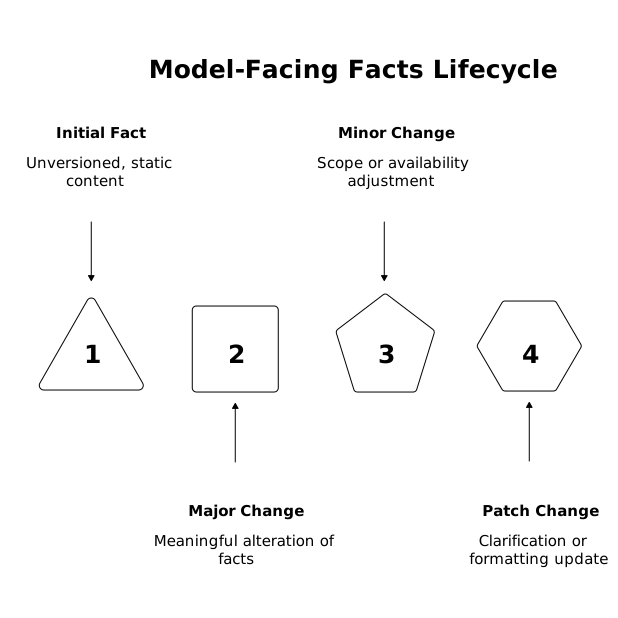
If you publish content that can change (pricing, policies, features, availability, compliance statements), don’t treat those sentences as “copy.” Treat them as facts with lifecycle rules. A useful mental model is semantic versioning:
- Major change: meaning changes (e.g., “free plan removed”).
- Minor change: scope changes (e.g., “available in 8 countries” becomes “10 countries”).
- Patch change: clarification or formatting with no meaning change.
When you adopt this model, LLM updates stop being mysterious. You can point any downstream consumer—search engines, AI agents, internal tools, partner scrapers—to exactly which “release” of a fact is valid.
Three fields that make web facts easier for AI to update
1) A stable fact identifier
Give important claims an internal ID that stays constant across revisions. This can be embedded in your HTML as a data attribute, in JSON-LD, or in a visible “Fact card” component used sitewide.
Examples of claims that benefit from IDs:
- Primary product promise (“We optimize AEO and GEO reporting”)
- Eligibility rules (“Available to EU customers”)
- Security and data handling (“Data retained for 30 days”)
- Integrations list (“Connects to any website”)
The goal is simple: when a model or crawler sees the same ID with a newer version, it can align “this is the same fact, updated,” not “two different paragraphs that conflict.”
2) A last-updated timestamp that is unambiguous
LLMs and crawlers need clear recency cues. Add a visible Last updated date near high-impact claims, and mirror it in structured data or metadata. Avoid vague phrasing like “recently” or “updated this month.” Use an exact date.
Where to apply timestamps:
- Pricing, plans, trials, or discounts
- Policy pages (terms, privacy, security)
- Feature availability and supported platforms
- Benchmarks, case study metrics, and performance stats
This is especially important when you publish “snippet-ready” sections that models quote verbatim. Without a timestamp, older extracts can look equally valid.
3) Deprecation and replacement signals
Most sites update a page by overwriting text. That solves human reading, but it can confuse AI systems that already captured the older wording. Instead, keep a small audit trail:
- Deprecated: mark a claim as no longer valid.
- Replaced by: link the deprecated claim to the new fact ID/version.
- Effective date: state when the new claim becomes true.
You don’t need to keep entire old pages public. You can keep a compact “changelog for facts” that explains what changed and when. This helps retrieval systems resolve conflicts and reduces the chance that an LLM repeats an outdated statement with high confidence.
How to structure snippet-ready sections so they don’t go stale
LLMs tend to lift short, self-contained passages. Create a dedicated snippet module for each core topic (what you do, who it’s for, how it works, constraints). Then make that module version-aware.
Practical pattern:
- A short Answer block (2–4 sentences) that can be quoted safely
- A Fact table (IDs + timestamps) for key claims
- A Change note when something was deprecated or replaced
This also reduces internal contradictions across your site. Many staleness problems aren’t caused by old caches—they’re caused by the same claim appearing in five places and only being updated in two.
Versioning strategy for fast-moving pages
Some page types change constantly. If you treat them like static marketing pages, you’ll keep leaking stale facts into AI answers.
Pricing and packaging
Maintain a canonical “pricing facts” section with explicit effective dates. If you run time-bound offers, separate “standard pricing” from “promotion facts,” each with their own timestamps and expirations.
Integrations and compatibility
Integrations lists get stale quickly. Use a single source of truth and render it everywhere (docs, landing pages, help center). If your stack supports it, generate these sections from structured content (a schema-driven form) rather than freehand edits. The same idea shows up in schema-driven internal tool forms with runtime validation, where structured defaults and validation reduce drift.
Performance claims and benchmarks
If you publish metrics, attach methodology and a timestamp. When the methodology changes, that’s a major version bump. When sample size changes, that may be a minor bump. The point is not bureaucracy—it’s preventing models from mixing incomparable numbers.
Deprecation that works in practice
Deprecation fails when it’s implicit. Make it explicit in three places:
- On the page: a short note that a claim was replaced, with date and pointer to the new statement.
- In structured outputs: JSON-LD fields or metadata indicating validity windows (validFrom/validThrough-style thinking, even if you implement it in custom fields).
- In internal operations: a lightweight review queue so changes to “high-impact facts” trigger checks across all surfaces.
Teams that already separate user feedback signals often implement this faster, because they distinguish “copy tweaks” from “truth changes.” A similar separation principle is described in a two-queue feedback system—the same thinking applies to content maintenance: not every edit needs a lifecycle event, but some absolutely do.
Monitoring how LLMs interpret your content after changes
Even with excellent versioning, you still need to verify whether AI systems picked up your update. That requires monitoring across multiple LLM surfaces and prompts, because each system may cite or paraphrase different parts of your site.
This is where an AEO/GEO-focused agent can be useful. lunem connects directly to websites, tracks how content is interpreted and surfaced, and helps teams spot where outdated snippets persist. When you pair monitoring with versioned facts, you can move from “we updated the page” to “we confirmed the new fact is the one models repeat.”
A lightweight implementation checklist
- Inventory the 20–50 highest-impact claims on your site (pricing, policies, eligibility, core product statements).
- Assign each claim a stable ID and store it in a structured source of truth.
- Add visible “Last updated” dates for snippet-prone sections.
- Create a deprecation pattern: deprecated flag, replaced-by pointer, and effective date.
- Reduce duplication by rendering facts from a single structured source.
- Monitor AI surfaces to confirm updates propagate and stale snippets decline.